Hopf, Nordin
Information och nedladdningar
Information and downloads
Informationen und Downloads
Välj ditt språk
Select your language
Wählen Sie Ihre Sprache
Få nyhetsbrev
Get newsletter
Newsletter erhalten
Om Hopf, Nordin
About Hopf, Nordin
Über Hopf, Nordin

Andreas Hopf och Axel Nordin träffades vid Lunds universitet och arbetar tillsammans sedan 2012 med att designa belysning, möbler och tillbehör
"Vi hämtar ofta inspiration från oväntade möten mellan till exempel ett sedan länge glömt hantverk, ett tillsynes vardagligt material eller ett fantasieggande naturfenomen
Bra design är konsekvent och ärlig. Den berättar historier och ställer frågor. Varför ser till exempel många lampor ut som om Thomas Edison precis lämnat sitt laboratorium när LED-tekniken möjliggör så många andra uttryckssätt? Varför inte leka med traditionerna, eller vika av från det etablerade när förutsättningarna har ändrats?
Man skulle kunna säga att våra föremål har olika karaktärer, vars form och funktion drivs av en strävan efter innovativa lösningar istället för förgängliga trender. Vi vill att våra produkter ska vara beständiga, vilket kräver att de är både användbara och fängslande"
Hopf, Nordin har ställt ut i Stockholm, Milano och London - 100% Design Futures London 2012, Biennale Internationale Design Saint-Étienne Artifact 2013, Stockholm Furniture Fair Greenhouse 2013, 2014 och 2016, Ventura Lambrate och Brera Design District Milan 2014 och 2015
Andreas Hopf and Axel Nordin met at Lund University in Sweden and began designing lighting, furniture and accessories in 2012
“For us, the most promising inspirations often come by way of unexpected encounters – with an archaic craft, a seemingly trivial material or an enigmatic natural phenomenon
Good designs are consequent and truthful; they tell stories and ask questions. For example – why do luminaires in the age of the LED often look as if Alva Edison just left his laboratory? Why not play with traditions or put them to bed, when technological conditions and human behaviour have evolved?
One could say that our objects are characters; their form and function guided by a conceptual strategy, not fleeting trends. We want our products to be lasting and relevant, that means both useful and always intriguing”
Designs by Hopf, Nordin were exhibited in Stockholm, Milan and London - 100% Design Futures London 2012, Biennale Internationale Design Saint-Étienne Artifact 2013, Stockholm Furniture Fair Greenhouse 2013, 2014 and 2016, Ventura Lambrate and Brera Design District Milan 2014 and 2015
Andreas Hopf und Axel Nordin lernten sich an der Universität Lund in Schweden kennen und entwerfen seit 2012 Leuchten, Möbel und Accessoires
„Für uns entwickeln sich die spannendsten Inspirationen oft aus Zufallsbekanntschaften – mit einem archaischen Handwerk, einem vermeintlich alltäglichen Material oder einem rätselhaften Naturphänomen
Gute Entwürfe sind konsequent und wahrhaftig; sie erzählen Geschichten und stellen Fragen. Warum sehen z. B. Leuchten im Zeitalter der LED oft noch so aus, als wäre Alva Edison gerade erst aus seinem Labor gekommen? Warum nicht mit Traditionen spielen oder sie brechen, wenn sich Lebenswelt und technologische Voraussetzungen grundlegend verändern?
Man könnte sagen, dass unsere Objekte eigensinnig sind, in Form und Funktion einem Konzept verhaftet und nicht flüchtigen Trends. Wir möchten, dass unsere Entwürfe beständig sind, zweckmäßig und inspirierend zugleich“
Designs von Hopf, Nordin wurden in Stockholm, Mailand und London ausgestellt - 100% Design Futures London 2012, Biennale Internationale Design Saint-Étienne Artifact 2013, Stockholm Furniture Fair Greenhouse 2013, 2014 und 2016, Ventura Lambrate und Brera Design District Milan 2014 und 2015
Kontakt
Contact
Kontakt
Hopf, Nordin
An der Industriebahn 12-16
13088 Berlin
Tyskland
Tel. +49 (0)30 4809 5864
E-mail...
Hopf, Nordin
An der Industriebahn 12-16
13088 Berlin
Germany
Tel. +49 (0)30 4809 5864
E-mail...
Hopf, Nordin
An der Industriebahn 12-16
13088 Berlin
Deutschland
Tel. +49 (0)30 4809 5864
E-mail...
PDF broschyr och bilder
PDF brochure and photos
PDF Broschüre und Fotos

Flute
Bordslampa
Table luminaires
Tischleuchten
Från ljud till ljus
From sound to light
Vom Klang zum Licht
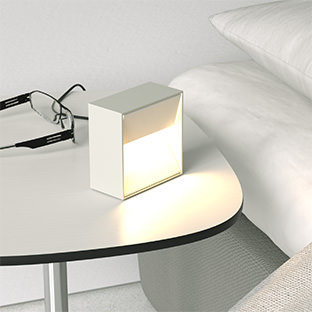
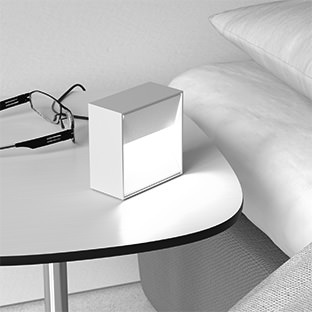
Inspirationen kommer från arbetsprincipen bakom gamla träorglars pipor. Ljuset från en ljusstark LED studsar runt i lampans inre för att sedan dyka upp mjukt och bländfritt i dess öppning. Flute består av två aluminiumdelar inuti en aluminiumram, vilket möjliggör färgkombinationer som antingen förstärker den minimalistiska formen, eller som gör att den smälter in i omgivningen. Ljusstyrkan kan varieras genom beröring av lampans ram. En tidlös detalj för bokhyllor och sido- och sängbord
Inspired by the working principle of vintage organs’ wooden pipes, the light of a high-end LED is bounced internally to emerge soft and glare-free. Flute is made from two nested aluminium parts inside an aluminium frame, allowing for colour combinations that either accentuate its minimalist form, or make it blend into its surroundings. An iconic detail for sideboards, side and bedside tables, the luminaire is switched and dimmed by gentle touches
Die Klangerzeugung klassischer hölzerner Orgelpfeifen stand Pate für diese ikonische Leuchte, in der das Licht einer high-end LED intern mehrfach reflektiert und dann blendfrei abgestrahlt wird. Flute besteht aus zwei in einen Aluminiumrahmen gesteckten Aluminiumteilen, wodurch sich Farbkombinationen ergeben, die die minimalistische Form der Leuchte betonen oder mit ihrer Umgebung verschmelzen lassen. Flute ist durch Berührung schalt- und dimmbar; ein schnörkelloses Accessoire, das besonders auf Sideboards, Beistell- und Nachttischen zur Geltung kommt
Färger och ytbehandlingar
Colours and finishes
Farben und Oberflächen
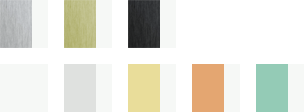
Borstad aluminium, eloxerad naturlig eller champagne; eller pulverlackerad aluminium RAL 9016, 7035, 1014, 3012, 6034
Brushed aluminium, anodised natural or champagne; or powder coated aluminium RAL 9016, 7035, 1014, 3012, 6034
Gebürstetes Aluminium, eloxiert natur oder champagner; oder pulverbeschichtetes Aluminium RAL 9016, 7035, 1014, 3012, 6034
Produktinformation
Product details
Produktdaten
FL - b 100 mm, h 100 mm, d 50 mm / 1 LED, 6.4 W, 520 lm
FL - w 100 mm, h 100 mm, d 50 mm / 1 LED, 6.4 W, 520 lm
FL - b 100 mm, h 100 mm, t 50 mm / 1 LED, 6.4 W, 520 lm
LED CCT 3000 K (CCT 3500 eller 2700 K tillval), Ra 90, energiklass A+, inbyggd, beröringsdimmer, inkl. strömförsörjning 230 VAC/15 VDC
Andra färger eller anodisation på förfrågan
LED CCT 3000 K (CCT 3500 or 2700 K optional), Ra 90, energy class A+, built-in, touch-dimmer, incl. power supply 230 VAC/15 VDC
Other paint or anodisation colours available upon request
LED CCT 3000 K (CCT 3500 oder 2700 K optional), Ra 90, Energieklasse A+, fest eingebaut, Touch-Dimmer, inkl. Steckernetzteil 230 VAC/15 VDC
Individuelle Lackierungen bzw. Farbeloxierungen auf Anfrage
Chinese Lattice
Bord
Tables
Tische
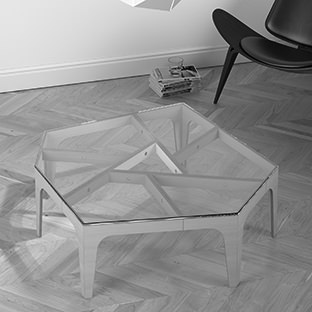
Nytt liv för en historisk hantverk
New life for an old craft
Historisches Handwerk neu entdeckt
Kinesiska gitter är en struktur som traditionellt använts i kinesiska fönster och dörrar. Utifrån konstruktionsregler som fördes vidare från generation till generation av hantverkare skapades träramar som bar upp rispapper. Efter deras uppkomst kring Choudynastin (1000 f Kr) föll de såsmåningom i glömska. Den amerikanska läraren Daniel Sheets Dye skickades till Chengdu 1910 för att etablera en skola, men väl där blev han så fascinerad av de kinesiska mönstren att han övergav sin ursprungliga uppgift och inledde en 20 år lång resa för att katalogisera mönstren med hjälp av sin assistent Yang Chi-Shang
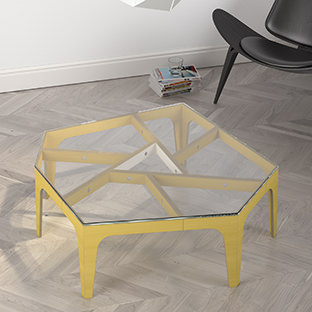
Borden, som hämtat inspiration från dessa mönster, är en uppsättning av trämoduler som tillsammans bildar ett lastbärande fackverk. Varje modul är tillverkad av plywood från hållbara skogsbruk i Finland. Chinese Lattice-borden kan enkelt monteras och demonteras på några minuter
Chinese Lattices are frameworks used in historic Chinese window and door construction. Created on site by craftspeople, from rules passed on to each new generation, they supported sheets of rice paper fitted to the wood. In use since their emergence in the Chou dynasty (1000 BC), they eventually faded into obscurity. The U.S. teacher Daniel Sheets Dye, sent to Chengdu in 1910 to establish a school, was so intrigued that he abandoned his original task and embarked on a 20-year journey, cataloguing the frameworks with the help of his draftsman Yang Chi-Shang
The tables - designed on that background - are modular trusses, where each individual frame is handmade from translucently colour-coated Finnish plywood from sustainable forestry. Depending on the viewing angle, spatial perception oscillates between structure and reflected surroundings. With only a coin for a tool, a Chinese Lattice shelf is easily assembled and dismantled in minutes
Chinese Lattices sind Fachwerke im historischen chinesischen Fenster- und Türenbau. Von Handwerkern vor Ort nach überlieferten Regeln erzeugt, gaben sie Reispapier, mit dem das Holz hinterklebt wurde, den nötigen Halt. Seit der Chou Dynastie (1000 v. Chr.) in Gebrauch, fielen die Strukturen dem Vergessen anheim. Der U.S.-amerikanische Lehrer Daniel Sheets Dye, 1910 zum Aufbau einer Schule nach Chengdu in die Provinz Sichuan entsandt, gab seine ursprüngliche Aufgabe auf, um statt dessen auf einer über 20 Jahre währenden Reise diese faszinierenden Strukturen mit Hilfe seines Zeichners Yang Chi-Shang zu katalogisieren
Die auf dieser Basis entworfenen Tische sind modulare Fachwerke, deren Rahmen von Hand aus farbig-transluzent beschichtetem finnischem Schichtholz aus nachhaltiger Forstwirtschaft zusammengefügt werden. Je nach Blickwinkel wechselt die Wahrnehmung zwischen Struktur und reflektierter Umgebung. Die Tische sind, mit nur einer Münze als Werkzeug, kinderleicht zusammen- und auseinanderzubauen
Färger och ytbehandlingar
Colours and finishes
Farben und Oberflächen
12 mm transparent vit, grå, gul, grön eller blå belagd finsk plywood från ett hållbart skogsbruk, skruvar i borstat rostfritt stål med platt huvud
12 mm transparent white, grey, yellow, green, blue or transparent coated Finnish plywood from sustainable forestry, brushed stainless steel flathead screws
12 mm starkes transparent weiß, grau, gelb, grün, blau oder transparent beschichtetes finnisches Schichtholz aus nachhaltiger Forstwirtschaft, gebürstete Edelstahl-Flachkopfschrauben

Produktinformation
Product details
Produktdaten
CLT 1 - Ø 1000 mm, h 298 mm; 7 ramar
CLT 1 - Ø 1000 mm, h 298 mm; 7 frames
CLT 1 - Ø 1000 mm, h 298 mm; 7 Rahmen
Bordsskivor 8 mm floatglas med slipade kanter, transparent dämpare
Större storlekar, också mat- och konferensbord, och enskilda färger på förfrågan
Tabletops 8 mm hardened glass with polished beveled edges, transparent glass dampers
Other sizes, also dining- and conference tables, and individual colours available upon request
Tischplatten 8 mm gehärtetes Glas mit geschliffenen Kanten, transparente Glasdämpfer
Sondergrößen, auch Eß- und Konferenztische, und individuelle Farben auf Anfrage
Fyr
Bords och hyllampor
Table and sideboard luminaires
Tisch- und Sideboardleuchten
En fyr för bordet
A desktop lighthouse
Ein Leuchtturm für den Tisch
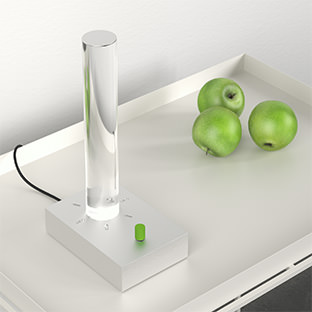
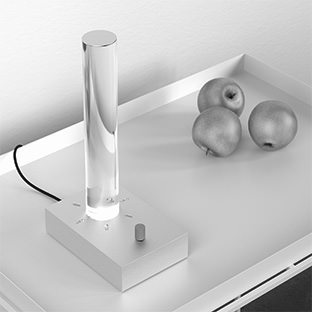
På den sydligaste bebodda ön i Finland finns den högsta fyren i de nordiska länderna, Bengtskärs fyr. Dess funktion och speciella form låg till grund för utformningen av denna bordslampa i två storlekar, som lyser 360°, något som inte tidigare uppnåtts med en enda LED. En kristallklar stav, hållen av en aluminiumbas i ett stycke, ser ut som om den glöder inifrån och lyser jämnt upp omgivningen. Fyr kan dimmas och stängas av med den räfflade ratten
The southernmost inhabited island of Finland is home to the highest lighthouse in the Nordic countries, the “Bengtskär Fyr”. Its function and exemplary form sparked off the design of this table and sideboard luminaire, available in two sizes, that illuminates through 360°, not before achieved with a single LED. A crystal-clear pole - mounted candle-like in an anodised aluminium monobloc housing – appears to glow from within when switched on, illuminating the surrounding perfectly evenly. Fyr can be dimmed with its knurled switching knob
Auf der südlichsten bewohnten Insel Finnlands steht der höchste Leuchtturm der nordischen Länder, das „Bengtskär Fyr“. Seine Funktion und markante Form waren Ausgangspunkt für den Entwurf dieser in zwei Größen erhältlichen Tisch- und Sideboard-Leuchte, die eine 360° Rundumbeleuchtung ermöglicht, wie sie mit nur einer einzigen LED noch nicht realisiert wurde. Ein im ausgeschalteten Zustand kristallklarer Stab - kerzengleich in ein Monoblock-Gehäuse aus eloxiertem Aluminium gesteckt - scheint nach dem Einschalten von innen zu strahlen, er leuchtet die Umgebung vollkommen gleichmäßig aus. Fyr ist am gerändelten Schalterknopf dimmbar
Färger och ytbehandlingar
Colours and finishes
Farben und Oberflächen
Borstad aluminium, eloxerad naturlig, champagne, svart; plexiglas
Brushed aluminium, anodised natural, champagne, black; plexiglas
Gebürstetes Aluminium, eloxiert natur, champagner, schwarz; Plexiglas

Produktinformation
Product details
Produktdaten
FY S - b 80 mm, d 100 mm, h 233 mm; 1 LED, 9.3 W, 946 lm
FY L - b 100 mm, d 150 mm, h 283 mm; 1 LED, 12.5 W, 1239 lm
FY S - w 80 mm, d 100 mm, h 233 mm; 1 LED, 9.3 W, 946 lm
FY L - w 100 mm, d 150 mm, h 283 mm; 1 LED, 12.5 W, 1239 lm
FY S - b 80 mm, t 100 mm, h 233 mm; 1 LED, 9.3 W, 946 lm
FY L - b 100 mm, t 150 mm, h 283 mm; 1 LED, 12.5 W, 1239 lm
LED CCT 3000 K (CCT 3500 eller 2700 K tillval), Ra 90, energiklass A+, inbyggd, dimmbar, inkl. strömförsörjning 230 VAC/15 VDC
Andra anodisation på förfrågan
LED CCT 3000 K (CCT 3500 or 2700 K optional), Ra 90, energy class A+, built-in, dimmer-switch, incl. power supply 230 VAC/15 VDC
Other anodisation colours available upon request
LED CCT 3000 K (CCT 3500 oder 2700 K optional), Ra 90, Energieklasse A+, fest eingebaut, Dimmerschalter, inkl. Steckernetzteil 230 VAC/15 VDC
Individuelle Farbeloxierungen auf Anfrage
Antiprisms
Taklampa
Pendant luminaires
Pendelleuchten
Ljusets geometri
Geometries of light
Geometrien des Lichts
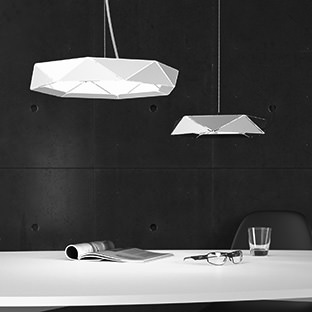
Redan 1525 beskrev Albrecht Dürer vikningen av tredimensionella kroppar i "Underweysung der Messung, mit dem Zirckel und Richtscheyt", som om han hade förutspått platta materials användning inom hållbar produktion
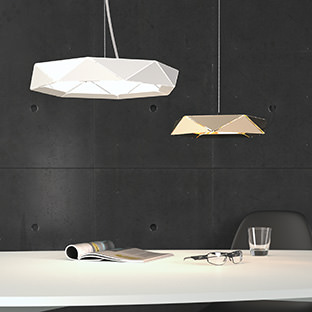
Likt ett stycke "renässans-origami" är varje lampa vikt för hand från en enda perforerad stålplåt. Vecken ger stabilitet och ljuset från perforeringarna tecknar geometriska mönster i rummet. Ringen av trianglar gör det möjligt att montera LED-modulerna så att de inte bländar, deras ljus samlas in och reflekteras utan skuggor av den matta insidan. Den spegelpolerade titannitrid-beläggningen och textilkabeln anspelar på historiska apparater inom rymdforskning. Antiprisms finns i många storlekar och ytbehandlingar och gör sig lika bra i restauranger, barer och lounges som över vardagsrumsbordet
Already in 1525 Albrecht Dürer described the folding of three-dimensional bodies in his “Underweysung der Messung, mit dem Zirckel und Richtscheyt”, as if he had anticipated the relevance for a sustainable making of goods from flat materials
Inspired by his “Renaissance-origami”, each luminaire is hand-folded from only a single perforated piece of steel. The folds provide stability and, by way of their perforations, trace the form with light into space. The ring of triangles provides for glare-free mounting of the LEDs, their light collected and reflected without drop shadows by the matte inner top face. The mirror polished titanium nitride coatings and sideways textile cable ducting allude to historic apparatuses in scientific and space research. Glare-free and available in various sizes and colours, Antiprisms are a good match for restaurants, bars and lounges and illuminate dining- and living room tables equally well
Schon 1525 beschrieb Albrecht Dürer die Faltbarkeit dreidimensionaler Körper in seiner „Underweysung der Messung, mit dem Zirckel und Richtscheyt“, als hätte er die Relevanz für die Herstellung nachhaltiger Produkte aus flachen Werkstoffen vorausgeahnt
Inspiriert durch sein „Renaissance-origami“ besteht jedes Antiprism aus einem einzigen perforierten und von Hand gefalteten Stahlteil. Die Faltungen verleihen der Leuchte Stabilität und zeichnen mit ihren Perforationen die Form mit Licht in den Raum. Der Ring aus Dreiecken ermöglicht eine blendfreie Anordnung der high-end LEDs, deren Licht von der mattierten Innenfläche gesammelt und schlagschattenfrei reflektiert wird. Die spiegelpolierten Titannitrid-Oberflächen und seitliche Textilkabelzuführung spielen auf historische Apparaturen aus Forschung und Raumfahrt an. In mehreren Größen und Oberflächen erhältlich, eignen sich Antiprisms für Restaurants, Bars und Lounges ebenso gut wie für die Blendfreie Beleuchtung von Besprechungs- oder Esszimmertischen
Färger och ytbehandlingar
Colours and finishes
Farben und Oberflächen
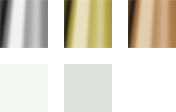
AP N5 S, AP N6 S pulverlackerad stål 9016, 7035; AP N5 L, AP N6 L, AP N 7 L pulverlackerad stål RAL 9016, 7035, spegelpolerad rostfritt stål eller titannitrid mässing
AP N5 S, AP N6 S powder coated steel 9016, 7035; AP N5 L, AP N6 L, AP N7 L powder coated steel RAL 9016, 7035, mirror-polished stainless steel or titanium nitride brass
AP N5 S, AP N6 S pulverbeschichteter Stahl RAL 9016, 7035; AP N5 L, AP N6 L, AP N 7 L pulverbeschichteter Stahl RAL 9016, 7035, spiegelpolierter Edelstahl oder Titannitrid Messing
Produktinformation
Product details
Produktdaten
AP N5 S (Pentaprism) - Ø 300 mm, h 50 mm; 5 LED, 16.0 W, 1325 lm
AP N6 S (Hexaprism) - Ø 325 mm, h 50 mm; 6 LED, 19.2 W, 1590 lm
AP N5 L (Pentaprism) - Ø 375 mm, h 60 mm; 5 LED, 16.0 W, 1325 lm
AP N6 L (Hexaprism) - Ø 400 mm, h 60 mm; 6 LED, 19.2 W, 1590 lm
AP N7 L (Heptaprism) - Ø 425 mm, h 60 mm; 7 LED, 22.4 W, 1855 lm
AP N5 S (Pentaprism) - Ø 300 mm, h 50 mm; 5 LEDs, 16.0 W, 1325 lm
AP N6 S (Hexaprism) - Ø 325 mm, h 50 mm; 6 LEDs, 19.2 W, 1590 lm
AP N5 L (Pentaprism) - Ø 375 mm, h 60 mm; 5 LEDs, 16.0 W, 1325 lm
AP N6 L (Hexaprism) - Ø 400 mm, h 60 mm; 6 LEDs, 19.2 W, 1590 lm
AP N7 L (Heptaprism) - Ø 425 mm, h 60 mm; 7 LEDs, 22.4 W, 1855 lm
AP N5 S (Pentaprism) - Ø 300 mm, h 50 mm; 5 LEDs, 16.0 W, 1325 lm
AP N6 S (Hexaprism) - Ø 325 mm, h 50 mm; 6 LEDs, 19.2 W, 1590 lm
AP N5 L (Pentaprism) - Ø 375 mm, h 60 mm; 5 LEDs, 16.0 W, 1325 lm
AP N6 L (Hexaprism) - Ø 400 mm, h 60 mm; 6 LEDs, 19.2 W, 1590 lm
AP N7 L (Heptaprism) - Ø 425 mm, h 60 mm; 7 LEDs, 22.4 W, 1855 lm
LED CCT 3500 K (CCT 3000 eller 2700 K tillval), Ra 90, energiklass A+, inbyggd, dimmbar med bakkantsstyrd dimmer, inkl. strömförsörjning 230 V och tak monteringssats
Andra storlekar och titannitrid guld eller titannitrid koppar på förfrågan
LED CCT 3000 K (CCT 3500 or 2700 K optional), Ra 90, energy class A+, built-in, dimmable with trailing-edge dimmer, incl. power supply 230 VAC and ceiling mounting kit
Larger sizes and titanium nitride gold or titanium nitride copper available upon request
LED CCT 3000 K (CCT 3500 oder 2700 K optional), Ra 90, Energieklasse A+, fest eingebaut, dimmbar mit handelsüblichen Phasenabschnittsdimmern, inkl. Netzteil 230 VAC und Deckenbefestigungszubehör
Sondergrößen sowie Beschichtung in Titannitrid Gold bzw. Titannitrid Kupfer auf Anfrage
Astrahedra
Taklampa
Pendant luminaires
Pendelleuchten
Universum i vardagsrummet
The universe in the living room
Der Weltraum im Wohnraum
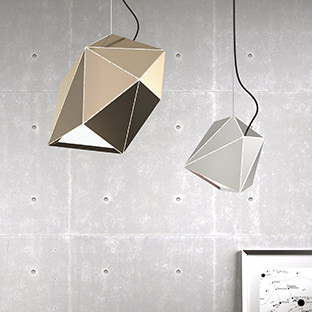
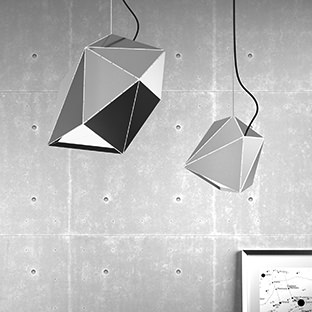
Sedan urminnes tider har vi spunnit myter och skapat tecken för att förankra oss i rymdens oändlighet och för att skapa ordning där våra sinnen når sin gräns. Vår stjärnhimmel är en tvådimensionell projektion av astronomiska föremål i ständig förändring, som ibland har upphört att existera när deras ljus väl når oss. Astrahedra är lysande skulpturer, var och en representerar en flisa av universum i en tredimensionell form
Astrahedra består av laserskurna ark av rostfritt stål, vikta längs tre sidor och sammanfogade med varandra. Perforeringarna längs med kanterna är upplysta från insidan och åskådliggör avståndet mellan stjärnorna som representeras av lampornas hörn. Oavsett om de hänger för sig själva som stora iögonfallande objekt, eller i en stjärnhop av mindre lampor så passar Astrahedra lika bra in i entréer och lobbys som i ett modernt hem
Since ever, we have wrapped the stars in myths and signs, to anchor ourselves in the boundlessness of space - to make sense where our senses must reach their limit. The universe is an ever-unfolding two-dimensional projection of astronomical objects that often have ceased to exist when their light eventually falls upon us. Astrahedra are illuminating sculptures, each representing a splinter of the Universe in three-dimensional tangible form
Sheet steel elements are bent and joined along their inner flaps. The perforated folds, illuminated from within, trace the true distances and positions between stars – the lights’ corners – into space. Whether as large eye-catching solitaire or cloud of smaller celestial bodies – Astrahedra are equally at home in entrance halls and lounges as well as the contemporary home
Von Anbeginn haben wir Sterne in Mythen und Zeichen gehüllt, um uns in der Unendlichkeit des Universums zu verankern - um Sinn zu stiften wo unsere Sinne an ihre Grenzen stoßen. Das Universum ist eine sich unmerklich entwickelnde zweidimensionale Projektion astronomischer Objekte, die oft schon nicht mehr existieren, wenn uns ihr Licht erreicht. Astrahedra sind Leuchtskulpturen, von denen jede einen Splitter des Universums dreidimensional abbildet und begreiflich macht
Mit Laschen versehene Stahlteile werden von Hand gefaltet und entlang ihrer Innenkanten verbunden. Die hinterleuchteten Perforationen geben die Lage und Entfernung zwischen Sternen – den Ecken der Leuchten – maßstäblich wieder. Ob als großer Solitär und optischer Blickfang oder in kleinerer Ausführung in Gruppen – Astrahedra sind in Eingangshallen und Lounges oder modernen Wohnzimmern gleichermaßen zu Hause
Färger och ytbehandlingar
Colours and finishes
Farben und Oberflächen
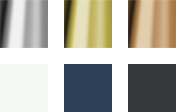
AH 1 S, AH 2 S pulverlackerad stål RAL 9016, 9011; AH 3 M, AH 4 M pulverlackerad stål RAL 9016, 7035, 9011; AH 5 L, AH 6 L pulverlackerad stål RAL 9016, 7035, 5013, 9011, spegelpolerad rostfritt stål eller titannitrid mässing
AH 1 S, AH 2 S powder coated steel RAL 9016, 9011; AH 3 M, AH 4 M powder coated steel RAL 9016, 7035, 9011; AH 5 L, AH 6 L powder coated steel RAL 9016, 7035, 5013, 9011, mirror-polished stainless steel or titanium nitride brass
AH 1 S, AH 2 S pulverbeschichteter Stahl RAL 9016, 9011; AH 3 M, AH 4 M pulverbeschichteter Stahl RAL 9016, 7035, 9011; AH5 L, AH6 L pulverbeschichteter Stahl RAL 9016, 7035, 5013, 9011, spiegelpolierter Edelstahl oder Titannitrid Messing
Produktinformation
Product details
Produktdaten
AH 1 S (Sheratan) - l 254 mm, b 205 mm, h 286 mm; E14
AH 2 S (Talitha Australis) - l 154 mm, b 302 mm, h 315 mm; E14
AH 3 M (Menkalinan) - l 302 mm, b 301 mm, h 317 mm; E27
AH 4 M (Kursa) - l 343 mm, b 301 mm, h 346 mm; E27
AH 5 L (Dsiban) - l 429 mm, b 460 mm, h 432 mm; E27
AH 6 L (Al Tais) - l 469 mm, b 376 mm, h 448 mm; E27
AH 1 S (Sheratan) - l 254 mm, w 205 mm, h 286 mm; E14
AH 2 S (Talitha Australis) - l 154 mm, w 302 mm, h 315 mm; E14
AH 3 M (Menkalinan) - l 302 mm, w 301 mm, h 317 mm; E27
AH 4 M (Kursa) - l 343 mm, w 301 mm, h 346 mm; E27
AH 5 L (Dsiban) - l 429 mm, w 460 mm, h 432 mm; E27
AH 6 L (Al Tais) - l 469 mm, w 376 mm, h 448 mm; E27
AH 1 S (Sheratan) - l 254 mm, b 205 mm, h 286 mm; E14
AH 2 S (Talitha Australis) - l 154 mm, b 302 mm, h 315 mm; E14
AH 3 M (Menkalinan) - l 302 mm, b 301 mm, h 317 mm; E27
AH 4 M (Kursa) - l 343 mm, b 301 mm, h 346 mm; E27
AH 5 L (Dsiban) - l 429 mm, b 460 mm, h 432 mm; E27
AH 6 L (Al Tais) - l 469 mm, b 376 mm, h 448 mm; E27
Inkl. tak monteringssats, ljuskälla ingår ej
Större storlekar och titannitrid guld eller titannitrid koppar på förfrågan
With ceiling mounting kit, lamp not included
Larger sizes and titanium nitride gold or titanium nitride copper available upon request
Inkl. Deckenbefestigungszubehör, ohne Leuchtmittel
Sondergrößen sowie Beschichtung in Titannitrid Gold bzw. Titannitrid Kupfer auf Anfrage
Chinese Lattice
Hyllor och rumsavdelare
Shelves and room dividers
Regale und Raumteiler
3000 år av mikroarkitektur
3000 years of micro-architecture
3000 Jahre Mikroarchitektur
Kinesiska gitter är en struktur som traditionellt använts i kinesiska fönster och dörrar. Utifrån konstruktionsregler som fördes vidare från generation till generation av hantverkare skapades träramar som bar upp rispapper. Efter deras uppkomst kring Choudynastin (1000 f Kr) föll de såsmåningom i glömska. Den amerikanska läraren Daniel Sheets Dye skickades till Chengdu 1910 för att etablera en skola, men väl där blev han så fascinerad av de kinesiska mönstren att han övergav sin ursprungliga uppgift och inledde en 20 år lång resa för att katalogisera mönstren med hjälp av sin assistent Yang Chi-Shang
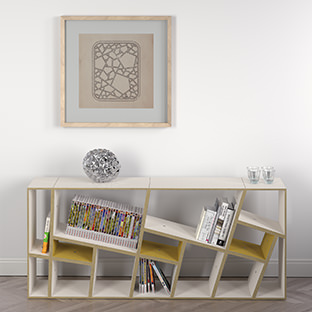
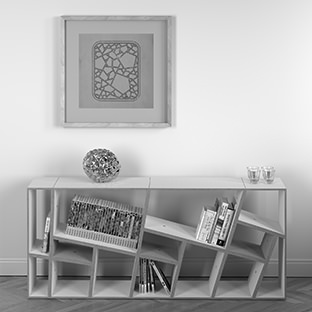
Hyllsystemet, som hämtat inspiration från dessa mönster, är en uppsättning av trämoduler som tillsammans bildar ett lastbärande fackverk. Varje modul är tillverkad av plywood från hållbara skogsbruk i Finland. Hyllorna behöver inga extra stöd utan kan enkelt dela upp stora utrymmen. Chinese Lattice-hyllorna kan enkelt monteras och demonteras på några minuter
Chinese Lattices are frameworks used in historic Chinese window and door construction. Created on site by craftspeople, from rules passed on to each new generation, they supported sheets of rice paper fitted to the wood. In use since their emergence in the Chou dynasty (1000 BC), they eventually faded into obscurity. The U.S. teacher Daniel Sheets Dye, sent to Chengdu in 1910 to establish a school, was so intrigued that he abandoned his original task and embarked on a 20-year journey, cataloguing the frameworks with the help of his draftsman Yang Chi-Shang
The shelf system, created in this context, is a set of interconnecting frames that form a self-supporting heavy-load-bearing truss. Each individual frame is made from translucently colour-coated Finnish plywood from sustainable forestry. No backing boards or tension wires disrupt the freestanding object’s transparency; even large spaces are easily subdivided. With only a coin for a tool, a Chinese Lattice shelf is easily assembled and dismantled in minutes
Chinese Lattices sind Fachwerke im historischen chinesischen Fenster- und Türenbau. Von Handwerkern vor Ort nach überlieferten Regeln erzeugt, gaben sie Reispapier, mit dem das Holz hinterklebt wurde, den nötigen Halt. Seit der Chou Dynastie (1000 v. Chr.) in Gebrauch, fielen die Strukturen dem Vergessen anheim. Der U.S.-amerikanische Lehrer Daniel Sheets Dye, 1910 zum Aufbau einer Schule nach Chengdu in die Provinz Sichuan entsandt, gab seine ursprüngliche Aufgabe auf, um statt dessen auf einer über 20 Jahre währenden Reise diese faszinierenden Strukturen mit Hilfe seines Zeichners Yang Chi-Shang zu katalogisieren
Das vor diesem Hintergrund gestaltete Regalsystem ist ein Verbund von Rahmen, die ein hochbelastbares selbsttragendes Fachwerk bilden. Jeder Rahmen ist aus farbig-transluzent beschichtetem finnischem Schichtholz aus nachhaltiger Forstwirtschaft zusammengefügt. Die Transparenz des freistehenden Objekts wird nicht durch versteifende Rückwände oder Spannvorrichtungen gestört; problemlos lassen sich selbst große Räume oder Hallen strukturieren – dabei ist ein Chinese Lattice Regal, mit nur einer Münze als Werkzeug, kinderleicht auf- und abzubauen
Färger och ytbehandlingar
Colours and finishes
Farben und Oberflächen
12 mm transparent vit, grå, gul, grön eller blå belagd finsk plywood från ett hållbart skogsbruk, skruvar i borstat rostfritt stål med platt huvud
12 mm transparent white, grey, yellow, green or blue coated Finnish plywood from sustainable forestry, brushed stainless steel flathead screws
12 mm starkes transparent weiß, grau, gelb, grün oder blau beschichtetes finnisches Schichtholz aus nachhaltiger Forstwirtschaft, gebürstete Edelstahl-Flachkopfschrauben

Produktinformation
Product details
Produktdaten
CLS 1 - b 1500 mm, h 2000 mm, d 350 mm; 21 ramar
CLS 2 - b 1750 mm, h 750 mm, d 350 mm; 14 ramar
CLS 1 - w 1500 mm, h 2000 mm, d 350 mm; 21 frames
CLS 2 - w 1750 mm, h 750 mm, d 350 mm; 14 frames
CLS 1 - b 1500 mm, h 2000 mm, t 350 mm; 21 Rahmen
CLS 2 - b 1750 mm, h 750 mm, t 350 mm; 14 Rahmen
Zell
Bord
Tables
Tische
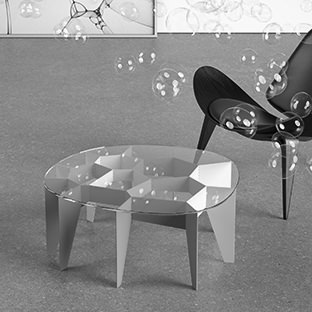
Naturen som arkitekt
Nature as architect
Die Natur als Architekt
Inspirationen bakom att låta möbler växa fram utifrån principer från naturen kom från det häpnadsväckande faktum att helt orelaterade naturfenomen som solens yta, trollsländsvingar eller havsskum kan modelleras med samma princip – Voronoidiagram, uppkallade efter Georgy Feodosevich Voronoy som upptäckte dem 1908
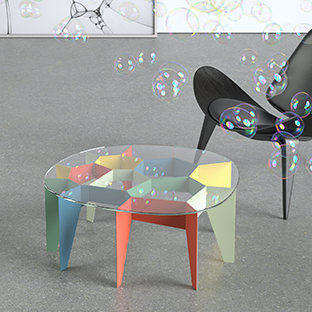
Strukturen som bär upp bordsskivan är lätt och transparent, tillverkad av slutna och öppna celler av handbockad perforerad stålplåt. Cellerna är sammanbundna med lim som används inom flygplansindustrin, vilket gör att inga överflödiga detaljer som skruvar eller nitar stör strukturens karaktär. Oavsett om borden är lackerade i diskreta naturfärger eller i extravaganta accentfärger så gör de sig bra i såväl exklusiva lobbys och väntrum som i ett modernt hem
Our idea to grow furniture with nature’s maths was inspired by the surprising fact that the characteristic of absolutely unrelated natural phenomena - like the Sun’s surface pattern, the formation of dragonfly wings or the structure of foam - can be derived through the very same method – Voronoi diagrams, named after Georgy Feodosevich Voronoy, who discovered them in 1908
The tables are lightweight transparent load-bearing trusses, made from closed and open cells, consisting of hand-folded perforated sheet steel pieces. The cells are joined with a performance adhesive used in aircraft construction – no superfluous details like screws or rivets diminish the structure’s character. Whether with discreet or flamboyant lacquering, the tables enhance upscale lobbies and waiting areas and compliment contemporary domestic settings
Ursprung unserer Idee, Möbel mit Mitteln der Natur wachsen zu lassen, ist die überraschende Tatsache, dass die Ausprägung völlig unverwandter Naturphänomene - wie die Muster der Sonnenoberfläche, der Aufbau von Libellenflügeln oder die Struktur von Schaum - mit ein und der selben Methode beschrieben werden kann; mit Voronoi Diagrammen, benannt nach dem Mathematiker Georgi Feodosjewitsch Voronoi, der sie 1908 entdeckte
Die Tische sind leichte transparente Tragwerke aus geschlossenen und offenen Zellen, bestehend aus von Hand gefalteten perforierten Stahlteilen. Die Zellen sind mit einem Konstruktionsklebstoff aus dem Flugzeugbau verbunden – keine überflüssigen Details wie Schrauben oder Nieten mindern die Präsenz der Struktur. Ob mit dezenter oder markanter Lackierung - die Tische sind gleichermaßen für repräsentative Eingangs- und Wartebereiche sowie als ausdruckstarkes Objekt im Wohnumfeld geeignet
Färger och ytbehandlingar
Colours and finishes
Farben und Oberflächen
Pulverlackerad stål RAL 9016, 7035, 9011, 1014, 1016, 2004, klarlackat stål; Z L också i spegelpolerat rostfritt stål
Powder coated steel RAL 9016, 7035, 9011, 1014, 1016, 2004, clear coated steel; Z L also in mirror-polished stainless steel
Pulverbeschichteter Stahl RAL 9016, 7035, 9011, 1014, 1016, 2004, klarlackierter Stahl; Z L zusätzlich auch aus spiegelpoliertem Edelstahl

Produktinformation
Product details
Produktdaten
Z S (lampbord) - Ø 600 mm, h 348 mm; 9 ramar
Z M (soffbord) - Ø 800 mm, h 328 mm; 15 ramar
Z L (loungebord) - Ø 1100 mm, h 308 mm; 20 ramar
Z S (side table) - Ø 600 mm, h 348 mm; 9 cells
Z M (coffee table) - Ø 800 mm, h 328 mm; 15 cells
Z L (lounge table) - Ø 1100 mm, h 308 mm; 20 cells
Z S (Beistelltisch) - Ø 600 mm, h 348 mm; 9 Zellen
Z M (Couchtisch) - Ø 800 mm, h 328 mm; 15 Zellen
Z L (loungetisch) - Ø 1100 mm, h 308 mm; 20 Zellen
Bordsskivor 8 mm floatglas med slipade kanter, transparent dämpare
Större storlekar, också mat- och konferensbord, och enskilda färger eller varianter för utomhusbruk på förfrågan
Tabletops 8 mm hardened glass with polished bevelled edges, transparent glass dampers
Other sizes, also dining- and conference tables, and individual colours or outdoor versions available upon request
Tischplatten 8 mm gehärtetes Glas mit geschliffenen Kanten, transparente Glasdämpfer
Sondergrößen, auch Eß- und Konferenztische, und individuelle Farben sowie outdoor Versionen auf Anfrage
Voronoi Cell
Hyllor och rumsavdelare
Shelves and room dividers
Regale und Raumteiler
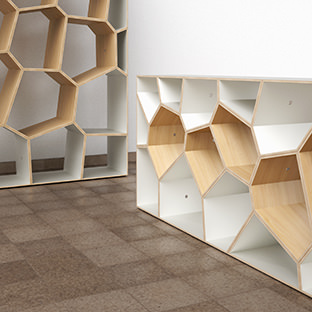
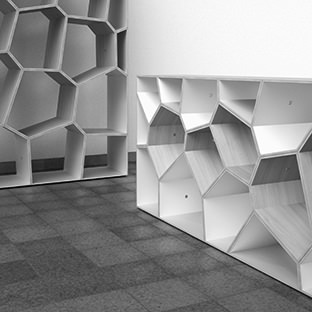
Naturen som arkitekt
Nature as architect
Die Natur als Architekt
Inspirationen bakom att låta möbler växa fram utifrån principer från naturen kom från det häpnadsväckande faktum att helt orelaterade naturfenomen som solens yta, trollsländsvingar eller havsskum kan modelleras med samma princip – Voronoidiagram, uppkallade efter Georgy Feodosevich Voronoy som upptäckte dem 1908
Our idea to grow furniture with nature’s maths was inspired by the surprising fact that the characteristic of absolutely unrelated natural phenomena - like the Sun’s surface pattern, the formation of dragonfly wings or the structure of foam - can be derived through the very same method – Voronoi diagrams, named after Georgy Feodosevich Voronoy, who discovered them in 1908
Ursprung unserer Idee, Möbel mit Mitteln der Natur wachsen zu lassen, ist die überraschende Tatsache, dass die Ausprägung völlig unverwandter Naturphänomene - wie die Muster der Sonnenoberfläche, der Aufbau von Libellenflügeln oder die Struktur von Schaum - mit ein und der selben Methode beschrieben werden kann; mit Voronoi Diagrammen, benannt nach dem Mathematiker Georgi Feodosjewitsch Voronoi, der sie 1908 entdeckte
Färger och ytbehandlingar
Colours and finishes
Farben und Oberflächen
12 mm transparent vit, grå, gul, grön eller blå belagd finsk plywood från ett hållbart skogsbruk, skruvar i borstat rostfritt stål med platt huvud
12 mm transparent white, grey, yellow, green or blue coated Finnish plywood from sustainable forestry, brushed stainless steel flathead screws
12 mm starkes transparent weiß, grau, gelb, grün oder blau beschichtetes finnisches Schichtholz aus nachhaltiger Forstwirtschaft, gebürstete Edelstahl-Flachkopfschrauben

Produktinformation
Product details
Produktdaten
#
#
#
Elva
Zen i kontor
Boardroom Zen
Konferenztisch-Zen
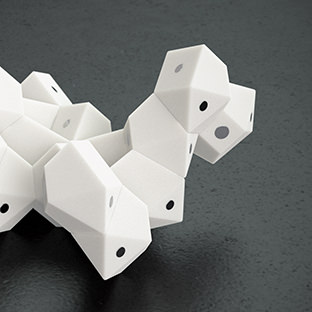
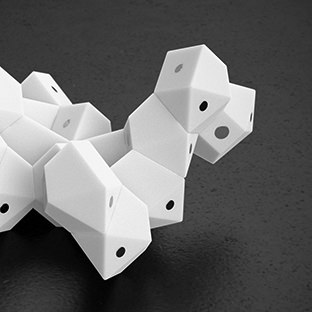
Skulptur... kristall... pussel? Elva är vad du gör det till!
Sculpture... crystal... puzzle? Elva is what you make of it!
Skulptur... Kristall... Puzzle? Elva ist was Du daraus machst!
Elva består av elvasidiga byggstenar vikta för hand av metallplåt. I varje byggsten finns dolda neodymmagneter med olika polaritet. Genom att utforska olika kombinationer av byggstenarna visar sig ett underliggande system som tillåter både regelbundna och friare, mer figurativa sammankopplingar. De handpolerade ytorna av mässing, koppar eller nickel glimrar som speglar i ett ett kalejdoskop, och får allteftersom en vacker patina
Säg adjöss till tråkiga möten...
Elva consists of eleven-sided handmade sheet-metal elements, each fitted with hidden neodymium magnets without obvious polarity. Through playful combination, a system reveals itself, allowing for regular or figurative assemblies. The hand-lapped brass, copper or nickel facets shimmer kaleidoscopically, revealing their beautiful oxidised quality over time
Time to kiss boring meetings good-bye...
Elva besteht aus elfseitigen handgefalteten Metallelementen, wobei unter einigen Seiten Neodym-Magnete ohne Kennzeichnung der Polung verborgen sind. Durch spielerisches Ausprobieren wird ein System erkennbar, mit dem sich nach Belieben regelmäßige oder freie Arrangements zusammensetzen lassen. Die handpolierten Facetten aus Messing, Kupfer oder Nickel schimmern kaleidoskopartig und offenbaren mit der Zeit ihr natürliches oxidiertes Erscheinungsbild
Sage eintönigen Meetings auf Wiedersehen...
Färger och ytbehandlingar
Colours and finishes
Farben und Oberflächen
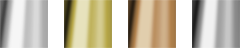
Nysilver, mässing, koppar, spegelpolerad rostfritt stål
Nickel silver, brass, copper, mirror-polished stainless steel
Neusilber, Messing, Kupfer, spiegelpolierter Edelstahl
Produktinformation
Product details
Produktdaten
E S – set med fem delar
E M – set med nio delar
E L – set med tretton delar
Storlek per del b 70 mm, h 52 mm, d 70 mm; vikt 50g; Neodymmagneter, polerduk. Ställ inte i närheten av elektronik!
E S - set with 5 pieces
E M - set with 9 pieces
E L - set with 13 pieces
Element size w 70mm, h 70mm, d 52mm; weight 50g; Neodymium magnets, polishing cloth. Do not place on sensitive electronic devices!
E S - Satz mit 5 Stück
E M - Satz mit 9 Stück
E L - Satz mit 13 Stück
Elementgröße b 70mm, h 70mm, t 52mm; Gewicht 50g; Neodym-Magnete, Poliertuch. Nicht auf empfindliche elektronische Geräte legen!
Andra storlekar och enskilda färger finns på begäran
Other sizes and individual paint colours available upon request
Sondergrößen und -lackierungen auf Anfrage
Ladda ner broschyr och foton
Download brochure and Photos
Broschüre und Fotos herunterladen
